

Our Blog
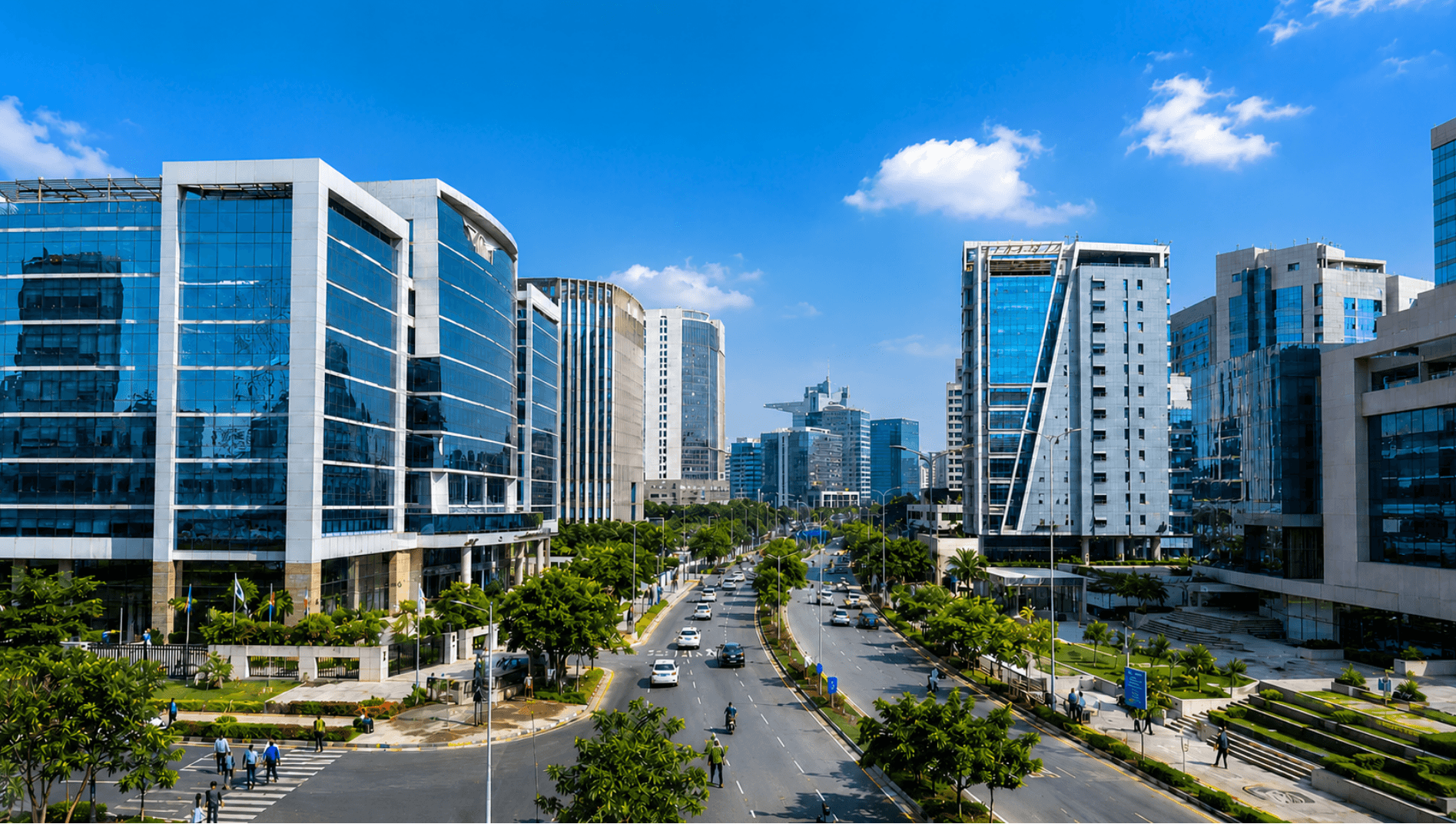
Hyderabad's western growth corridor is not one office market. It is three overlapping ones, each with a distinct tenant profile, price point, and reason for existing. HITEC City is the original, mature IT district. Gachibowli is the balanced middle ground that most enterprise teams end up choosing. The Financial District is the newest and most premium of the three, built specifically around the GCC and BFSI wave.
Office costs vary considerably across the three corridors, depending on the building, location, specification and lease structure, so headline rental rates alone do not tell the full story.
THE QUICK ANSWER: Choose HITEC City if you need metro-first connectivity and access to Hyderabad's deepest pure-IT talent pool. Choose Gachibowli if you want Grade A infrastructure, strong Outer Ring Road (ORR) access and an established enterprise ecosystem without necessarily prioritising the premium positioning of HITEC City. Choose the Financial District if your priority is a premium address, ISB-adjacent talent, and airport connectivity, and you are willing to pay for it.
HITEC City, short for Hyderabad Information Technology and Engineering Consultancy City, is where Hyderabad's tech economy started, and it still functions as the epicenter of that ecosystem. It sits closest to the metro, with direct access via the Blue Line, and connects to the rest of the city through the Outer Ring Road and an extensive bus network.
The tradeoff for that maturity is price. Office space here is generally the most expensive of the three corridors, reflecting both premium positioning and genuine supply constraints. The residential market tells the same story: HITEC City has already crossed its growth phase and is now considered saturated, which pushes both office and housing costs upward. Residential demand around HITEC City has remained strong, supported by continued employment growth and the area's established position within Hyderabad's technology ecosystem, driven by continued IT hiring even as available premium space stays tight.
Who it suits: IT and software companies that specifically need deep integration with Hyderabad's established tech ecosystem, and teams where metro access matters more than headline rent. It is generally the strongest fit for businesses hiring pure IT talent at volume.
Gachibowli sits geographically and strategically between the other two, north of the Financial District and south of HITEC City, and it has become the default choice for a large share of enterprise and GCC teams for exactly that reason. It offers Grade A infrastructure without paying the full premium commanded by either neighbor, while still giving a workforce spread across western Hyderabad's fast growing residential belt strong ORR access.
The numbers back this up directly: managed office space in Gachibowli runs 15 to 25 percent below equivalent specification space in HITEC City's prime zones. For larger teams, even relatively small differences in workspace costs can become meaningful over time, making it important to evaluate the total occupancy cost rather than the headline seat price alone. Managed-office pricing in Gachibowli varies by building, specification, seat configuration and lease structure, so businesses should compare like-for-like offerings before making a decision. Major campuses here include DLF Cyber City and Q City, and global tenants such as Microsoft, Amazon, Capgemini, and Google already maintain a significant presence in the area.
Gachibowli is also still considered to be in its growth phase, unlike the more saturated HITEC City market, which means the rental and leasing market here remains comparatively more flexible for negotiating terms. Residential demand around Gachibowli has also strengthened alongside the area's continued expansion as a major enterprise and technology corridor.
Who it suits: Startups looking for managed offices that can scale with their growth, SMEs seeking cost-effective plug-and-play workspaces, and GCCs requiring larger, flexible footprints without committing to a premium Financial District address. For many enterprise teams, it offers a practical balance of quality infrastructure, flexibility and operational convenience.
The Financial District, centered around Nanakramguda, is Hyderabad's newest and most consciously positioned commercial corridor, and it has become the preferred address for large businesses actively choosing where to set up. It anchors some of the city's most recognizable global tenants, including Deutsche Bank, JPMorgan Chase, and Wells Fargo, which alone signals the kind of company this corridor is built to attract.
Managed-office pricing in the Financial District varies depending on the building, specification, scale and level of customisation, making the overall value proposition more important than the headline seat price alone. The Financial District's case is not built on being the most pocket friendly option; it is built on five factors that make the decision credible to clients, hires, and leadership alike: address prestige, proximity to ISB and its talent and alumni network, direct metro connectivity via the Blue Line extension, convenient access to Rajiv Gandhi International Airport, an important consideration for businesses with frequent domestic and international travel requirements, and a genuinely mature Grade A building stock. Weekday foot traffic in the district is substantial, driven by the concentration of anchor financial tenants already established there.
The area is also expanding southward. Kokapet, just south of Nanakramguda, has emerged as a new growth frontier following record breaking government land auctions in 2024 and 2025, and is increasingly evaluated alongside the Financial District for airport heavy operations at a somewhat lower cost.
Who it suits: GCCs, BFSI firms, and enterprise businesses that prioritize address prestige, client facing credibility, and airport access over headline rent. It is also the strongest option for businesses that expect to draw heavily on ISB's talent pipeline and alumni network.
HITEC City. Typical seat pricing is the highest of the three. Market maturity is fully saturated and established. Metro access is the strongest, with a direct Blue Line connection. Airport distance is moderate. Anchor tenants are legacy IT and software firms. It is best suited for pure IT talent and metro dependent teams.
Gachibowli. Typical seat pricing runs Rs. 7,500 to Rs. 16,000 per seat. Market maturity is in a growth phase, with more flexible terms. Metro access is good and ORR dependent. Airport distance is moderate. Anchor tenants include Microsoft, Amazon, Capgemini, and Google. It is best suited for startups, SMEs, and GCCs wanting value.
Financial District. Typical seat pricing runs Rs. 6,000 to Rs. 10,000 per seat. Market maturity is the newest and fastest growing of the three. Metro access comes through the Blue Line extension. Airport distance is roughly 25 minutes. Anchor tenants include Deutsche Bank, JPMorgan, and Wells Fargo. It is best suited for GCCs, BFSI firms, and prestige driven enterprise.
Team size and lease commitment should be the primary filters before location even enters the conversation. A few rules of thumb apply broadly across all three corridors.
For shorter-term commitments, managed offices can offer a practical alternative to conventional warm-shell leases by reducing the time, capital and operational effort involved in setting up and running a workplace. When both options are evaluated on a comparable per-seat or total occupancy-cost basis. This is important because comparing managed workspace on a per-seat basis against a conventional lease quoted per square foot can give a misleading picture of the actual cost.
For smaller teams, Gachibowli's managed-office options can offer a practical balance of workspace quality, flexibility and access to the wider western Hyderabad business ecosystem.
For larger teams, particularly GCCs, the Financial District's Grade A office stock, established corporate ecosystem and premium positioning can make it a strong option, provided the location aligns with the company's budget and workforce requirements.
For IT specific hiring at volume, HITEC City's talent density and metro access remain difficult to replicate elsewhere in the corridor.
Do not choose based on rent alone. Address credibility, talent proximity, and commute patterns for your actual workforce, not just headline pricing, tend to matter more over a multi year lease than the per square foot difference between neighboring corridors.
None of these three corridors is objectively the best location in Hyderabad; each was effectively built for a different kind of business. HITEC City rewards companies that need deep IT talent access and don't mind paying a maturity premium for it. Gachibowli rewards companies that want strong infrastructure without either neighbor's full price tag. The Financial District rewards companies for whom prestige, talent pipeline, and airport access are worth the higher seat cost. The right answer depends less on which corridor has the best reputation and more on your team size, budget, lease horizon, and what your workforce actually needs to commute to each day.

Aakash Jain
Director